
Do You Really Need Dental X-Rays Every Year? Why and When Dentists Recommend
Getting dental X-rays is unnerving, and they tend to be expensive. You may also have heard about possible health problems associated with radiation from getting X-rays.
So, do you really have to get your teeth X-rayed once a year? We did the research to learn more about dental X-rays.
Read on to learn why dental X-rays are important and how often you need X-rays to maintain good oral health.
Table of Contents
- How Often Do You Need Dental X-Rays?
- Why Dentists Use X-Rays
- Different Types of Dental X-Rays
- FAQs About Dental X-Rays
- Regular X-Rays at Mint Dental Works Can Help Maintain the Health of Your Teeth
How Often Do You Need Dental X-Rays?
The American Dental Association (ADA) recently updated its recommendations on dental radiography safety in 2024, emphasizing that X-rays should be taken when clinically necessary to support diagnosis and ongoing care. Modern digital X-ray technology and smaller, targeted beam sizes have significantly reduced patient exposure, making routine dental imaging safe for all ages.
So, how often do you need dental X-rays? According to Mint Dental Works, a trusted SE Portland dentist, the answer depends on your individual needs. Dental X-rays are essential for detecting hidden decay, bone loss, and other issues that can’t be seen during a standard visual exam.
For most adults, bitewing X-rays are recommended annually or every other year to detect cavities between teeth and monitor gum and bone health. However, the frequency can vary depending on:
- Dental history
- Age
- Risk for disease
- Dental hygiene
- Gum disease
- Tooth decay
Mint Dental Works takes all of these into account when determining when to give X-rays. New patients are required to get a panoramic X-Ray, as well as four bitewings, to get a full picture of their dental health. If these have been done recently by another dentist, they can be sent over to Mint. After that, we suggest diagnostic X-rays of bitewings every one to two years, depending on any oral concerns, and a panoramic every five years to check health and catch any problems before they become emergencies.
Why Dentists Use X-Rays
The reality is that the human eye is limited. X-rays are needed to spot problems in the tooth and jaw before they become painful and dangerous.
For adults, dental X-rays can discover problems like:
- Hidden tooth decay between teeth and under fillings
- Bone loss in the jaw due to infection
- The condition of bones for dental work, such as implants and braces
- Abscesses occurring at the root of the tooth
- Certain types of cysts and tumors in the jaw
Dental X-rays are equally important for children. These X-rays can help monitor:
- Growing teeth
- Developing decay
- Wisdom teeth development
- Impacted teeth
- Missing adult teeth
Mint Dental Works uses specialty tools to take X-rays, ensuring they get the least amount of radiation possible. In fact, our digital dental X-rays emit 85% less radiation than traditional X-ray machines. If you are worried about safety, don’t be – Mint offers a safe dental experience every time.
Different Types of Dental X-Rays
Take the mystery out of dental X-rays by learning what the different types are, how they work, and what they are used for.
Intraoral
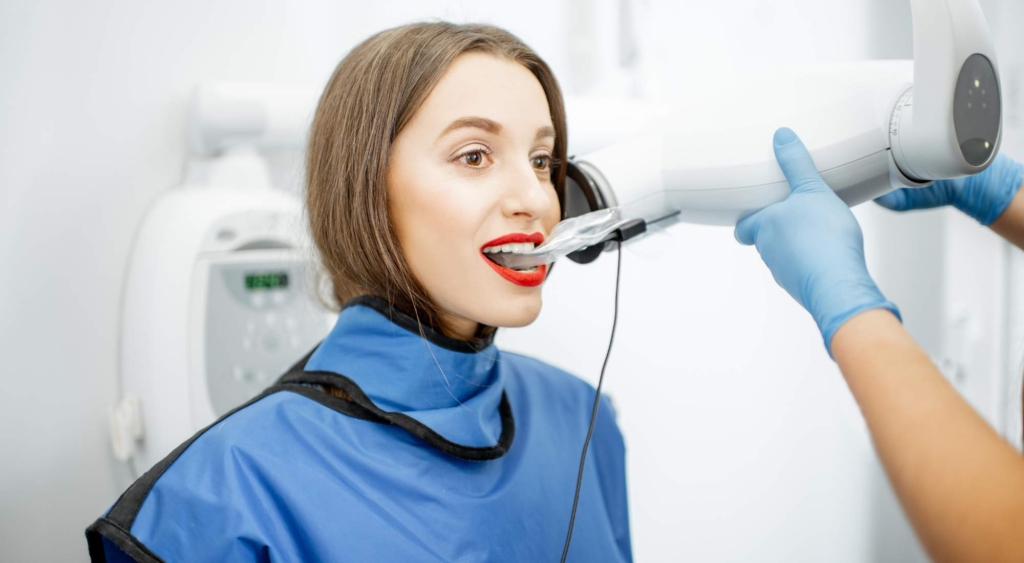
Intraoral X-rays are done on the inside of the mouth. These are the most common types of dental X-rays, used in dental offices nationwide. Intraoral X-rays allow dentists to check the health of the entire tooth, from the outside as well as the root and the jawbone.
Bite-Wing X-Rays
Bite-wing X-rays are very common in dental work because these X-rays can show a tooth from the crown to the root in the jawbone. They are used for:
- Detecting hidden decay between teeth and below the gumline
- Reviewing changes in bone density caused by gum disease
- Checking on the integrity of dental work, like crowns and fillings
Periapical X-Rays
Periapical refers to the root of the tooth and its surrounding tissues. Periapical X-rays show a section of teeth in the upper or lower jaw, specifically the tooth root and surrounding tissues. These X-rays are used to find problems or abnormalities in the root structure, such as abscesses.
Extraoral
Extraoral means dental X-rays taken outside the mouth.
Panoramic X-Rays
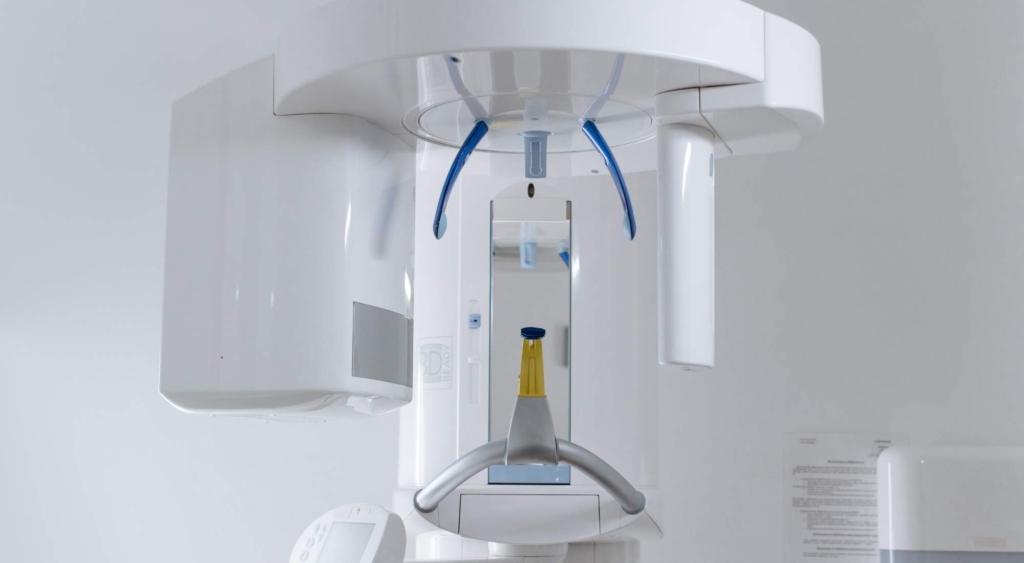
Panoramic X-rays provide a view that shows the entire area of the mouth, including upper and lower jaws. Panoramic X-rays are often used in orthodontics as well as dentistry because they show the position of fully emerged and emerging teeth.
For dentists, panoramic X-rays can find impacted teeth, emerging teeth, and possible tumors or cysts in the jaw.
Other Types of Extraoral X-Rays
Extraoral X-rays capture images from outside the mouth, providing broad views of the jaws, teeth, sinuses, and surrounding structures. They can be especially helpful for identifying hidden or complex conditions—such as impacted teeth, jaw abnormalities, or bone changes—that may not be visible with standard intraoral imaging.
- Cephalometric projections show the entire side of the head. They are used more often in orthodontics, where the placement of the teeth in the jaw and adjustment to the jaw profile need to be considered.
- A dental cone beam is essential in treatment planning because it provides precise, high-resolution 3D views of the teeth, jaws, nerves, airways, and joint structures, allowing dentists to map and measure anatomy with far greater accuracy than traditional 2D X-rays. Unlike a medical CT scan—which is designed for larger areas of the body, uses higher radiation, and provides broader but less targeted data—a cone beam is the only dental imaging method that can fully capture the detailed, localized anatomy of the head and jaws needed for a truly comprehensive diagnosis.
FAQs About Dental X-Rays
What Types of Patients May Need More Frequent X-Rays?
Some patients simply need more X-rays than others. These include:
- Children and teenagers – Emerging teeth need to be tracked to prevent problems. This is especially true for kids who have extensive tooth decay or are missing adult teeth.
- Adults with extensive dental work – If you have many crowns and fillings, additional X-rays may be needed to ensure that decay isn’t hiding beneath these restorations.
- Tobacco smokers and chewers – Tobacco causes receding gums and bone disease, which needs to be monitored by dentists.
- People with dry mouth – Dry mouth demineralizes teeth, which leads to many dental problems. Dry mouth is one of the many conditions that can contribute to cavities.
- Patients with a history of cavities and gum disease
Can Too Many Dental X-Rays Be Harmful?
X-rays use radiation, which can be harmful in high doses. However, it is important to note that modern dental equipment emits a very low amount of radiation. According to studies, you get more radiation from a cross-country flight than you do from a standard bite-wing intraoral X-ray.
The ADA has an acronym they use, ALARA, which means as low as reasonably achievable. That being said, the overall risk to health presented by dental X-rays is very low, whereas dental decay and disease can severely damage health and even become life-threatening. Mint Dental Works uses digital X-rays to minimize radiation and always uses safety equipment like lead bibs. Overall, it is a lot safer to get occasional dental X-rays than to avoid them entirely.

Are Dental X-Rays Safe During Pregnancy?
Generally, it is recommended that pregnant women avoid routine X-rays due to the remote possibility of damage to the fetus.
However, if there is an emergency, diagnostic and treatment dental X-rays can be performed with the proper shielding to protect the baby, such as a lead bib. In fact, both The American College of Obstetricians and Gynecologists (ACOG) and the American Dental Association (ADA) state that dental X-rays are safe during pregnancy when appropriate shielding is used. After all, dental pain can be indicative of some very dangerous conditions, like abscesses. If you are pregnant and have dental pain, it is much safer to go to the dentist than not!
What Is Preventive vs. Diagnostic Imaging?
Preventive dental X-rays allow dentists to find tooth decay and cavities before the root nerve is infected and becomes painful. By identifying these problems early through imaging, the results are not only less painful but also less involved.
In addition, diagnostic imaging can help monitor children’s teeth as they grow and get ahead of any problems.
Diagnostic imaging is used after dental symptoms appear. Diagnostic dental X-rays can help find where tooth damage is, such as an abscess at the root of the tooth or decay below the gumline. It can also be used to identify bone loss in the jaw caused by gum disease, aging, or smoking. Many severe dental problems exist below the surface, so without diagnostic X-rays, it can be impossible to find out what is causing pain.
Regular X-Rays at Mint Dental Works Can Help Maintain the Health of Your Teeth
Haven’t gone to the dentist in a while? Scared of getting X-rays? Don’t be! Mint Dental Works has the best and safest dental equipment. Our cutting-edge digital panoramic X-ray system exposes patients to up to 85% less radiation than a standard X-ray system. As a business, we are dedicated to getting you the safest dental experience possible. Not only do we use low radiation X-rays, but we also use safe cleaning materials, and mercury-free fillings and crowns.
As the premier SE Portland Dentist, we never do unnecessary X-rays or procedures. Mint Dental Works offers preventative, restorative, and cosmetic dentistry, as well as pediatric dentistry, to the greater Portland metro area. Check out our website to learn more.
The content in this blog is not intended to be a substitute for professional medical advice, diagnosis, or treatment. Always seek the advice of your physician or other qualified health provider with any questions you may have regarding a medical condition.